KIS: Her Film Blog by Patricia, Michelle, Gabrielle and Eleni
 |
Her
A Spike Jonze Film: 2013
126 minutes
Starring:
Joaquin Phoenix
Amy Adams
Rooney Mara
Olivia Wilde
Scarlett Johansson
Trailer
Synopsis
Theodore, a recently separated man living in Los Angeles in the near future, is on the search for a new love. He lives on his own in a big apartment and writes love letters for other people as his job. Theodore purchases a new operating system--the OS1--which he uses for his everyday needs.
The OS1 calls herself Samantha. These new OS1 models possess artificial intelligence that evolves over time. Samantha is able to have full conversations and is able to relate to a person’s feelings and life. The relationship between Samantha and Theodore that begins with Samantha fetching his emails, organizing his meetings, and proofreading his work to where they slowly begin to fall in love--Samantha even watches him as he sleeps. As in every other normal relationship, they face their issues but become stronger as a couple.
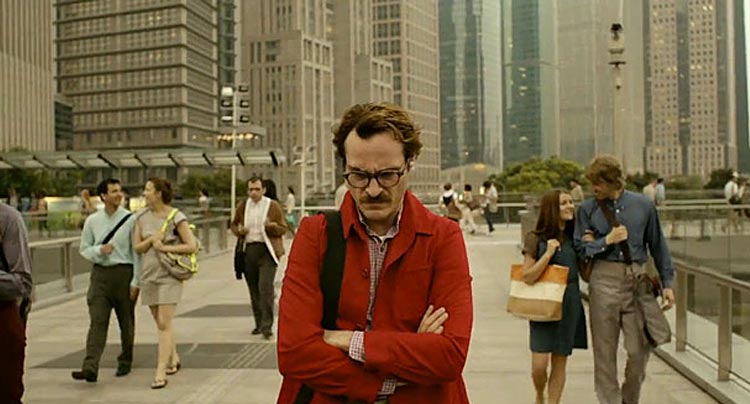
When Samantha realizes she does not have an actual body for Theodore, she brainstorms ideas on how to achieve that. After a bad encounter with a “surrogate,” Theodore comes to know the limits of his relationship with Samantha and begins to question his love for her. He then realizes that he truly does love her and does not want to be without her. But, another issue quickly rises to the surface. Samantha begins to meet new operating systems and starts to open her eyes towards different potential ways she could live her life. This causes issues with her relationship with Theodore. Samantha then becomes the one to realize that she is falling in love with different people--hundreds of them. Toward the end, Samantha and all the other OS1s leave and Theodore is left alone once again, but as a person who has emotionally developed.
Theodore, a recently separated man living in Los Angeles in the near future, is on the search for a new love. He lives on his own in a big apartment and writes love letters for other people as his job. Theodore purchases a new operating system--the OS1--which he uses for his everyday needs.
The OS1 calls herself Samantha. These new OS1 models possess artificial intelligence that evolves over time. Samantha is able to have full conversations and is able to relate to a person’s feelings and life. The relationship between Samantha and Theodore that begins with Samantha fetching his emails, organizing his meetings, and proofreading his work to where they slowly begin to fall in love--Samantha even watches him as he sleeps. As in every other normal relationship, they face their issues but become stronger as a couple.
When Samantha realizes she does not have an actual body for Theodore, she brainstorms ideas on how to achieve that. After a bad encounter with a “surrogate,” Theodore comes to know the limits of his relationship with Samantha and begins to question his love for her. He then realizes that he truly does love her and does not want to be without her. But, another issue quickly rises to the surface. Samantha begins to meet new operating systems and starts to open her eyes towards different potential ways she could live her life. This causes issues with her relationship with Theodore. Samantha then becomes the one to realize that she is falling in love with different people--hundreds of them. Toward the end, Samantha and all the other OS1s leave and Theodore is left alone once again, but as a person who has emotionally developed.
Editing
The film consisted of mainly long takes, “they unfolded in real time to allow the viewers to immerse themselves in the emotions and actions of the characters” (Golden, 5). For example, the scenes of dialogue between Samantha and Theodore are longer takes, the film revolves around their dialogue and interaction with one another to develop their connection and relationship with one another. Romance must be developed with time; for the audience to really connect with what takes place between the main characters, quick shots wouldn’t give off this effect. By having long takes-- as if it was taking place in front of you ---makes it more realistic for the audience to engage in and observe the surroundings.
Another example of this is when Theodore and Amy talk on the couch of her apartment. She discusses with him about how her marriage has fallen apart and what argument led to it. This scene develops the emotions of not only what she is going through during this difficult time but can give us insight into Theodore’s experience of divorce as well. This topic is prevalent in many people’s lives and the emotions are raw; long takes enable us who are inexperienced or not to understand the emotions that go on. The use of long takes in each of these cases is effective in creating an atmosphere for viewers to feel the emotions that the situations give off.
In the movie, “the method to move between images is through cuts, the images change instantaneously to create a continuous flow of the scene” (Golden, 4). This gives an effect, once again of making it feel as if your presence in the scene.The editor’s cuts are more of a smooth cut and allow the audience to transition between the images as if they were in their environment and simultaneously seeing all the frames in one particular setting and time. Cuts allow the film crew to not have to continuously change the movement of the camera (Golden, 4). An example of cut editing in the film is cutting from Theodore’s face to Amy’s face when they talk in her apartment, it feels like you're part of the conversation because you have the perspective of many angles. This is a very effective tool to allow the viewers to get comfortable with the surroundings of the characters and enabling us to engross ourselves in the scenario.
Another example of this is when Theodore and Amy talk on the couch of her apartment. She discusses with him about how her marriage has fallen apart and what argument led to it. This scene develops the emotions of not only what she is going through during this difficult time but can give us insight into Theodore’s experience of divorce as well. This topic is prevalent in many people’s lives and the emotions are raw; long takes enable us who are inexperienced or not to understand the emotions that go on. The use of long takes in each of these cases is effective in creating an atmosphere for viewers to feel the emotions that the situations give off.
In the movie, “the method to move between images is through cuts, the images change instantaneously to create a continuous flow of the scene” (Golden, 4). This gives an effect, once again of making it feel as if your presence in the scene.The editor’s cuts are more of a smooth cut and allow the audience to transition between the images as if they were in their environment and simultaneously seeing all the frames in one particular setting and time. Cuts allow the film crew to not have to continuously change the movement of the camera (Golden, 4). An example of cut editing in the film is cutting from Theodore’s face to Amy’s face when they talk in her apartment, it feels like you're part of the conversation because you have the perspective of many angles. This is a very effective tool to allow the viewers to get comfortable with the surroundings of the characters and enabling us to engross ourselves in the scenario.
Framing
Jonze uses mainly “close-ups to show the intense emotions” (Golden, 2) that resides in the facial expressions of Theodore in the film. When depicting a romance between two characters, it is typical to show shots where we can view the interaction between the two characters but in this particular case, this is a disadvantage. One of the characters in the relationship is an operating system without a body, so to allow the viewers to feel the emotions of the love that grows between them they must show us in other ways. The most common use in the film is by having the camera close up on Theodore’s face to enable the viewers to read his emotions and expressions, therefore to make conclusions to how he feels for Samantha. While we cannot read his actions, we can still read his facial expressions. We see him laugh and smile as he talks to Samantha, you can see the love that radiates from his face when he falls in love with her. Another example is the close-ups taken of Theodore's OS1 device, it depicted how valued this particular object was to him and how she would affect his life in the months to come after he had purchased her. The close-ups were effective in again feeling the intense emotions that reside in both Theodore and Samantha's relationship despite the unconventional nature.
Lighting
Many scenes throughout the film take place during the evening or when Theodore is waking up, therefore the lighting is low-key. Not much light is prevalent and lighting is not bright, white light but more of a yellow. The effect of this is is to make it a certain mood and make it dramatic. The yellow lighting makes it more warm toned and loving, not uncomfortable/cold. In addition, the darker lighting makes for a more intimate scene as you would spend more of your intimate time with your partner in the evening or early morning. An example is when Theodore lays in his bed at night and talks with Samantha, this is an intimate time between the two of them which will allow them to build their relationship. This technique is effective in portraying a deep connection between the two in their relationship and demonstrate that they hold something special.

In the film, high-key lighting is used occasionally and this is when he is on the beach and the lighting is what would be from the sun on a bright and sunny day. “The effect of this lighting is to portray the openness that the ocean creates and brightness” (Golden, 6). The lighting creates a normalcy to his life as anyone on a regular basis (daily) experiences the high-key lighting from the sun. “His motives are not hidden by light" (Golden, 6) but are shown through his desire for love, it gives contrast to his private life that is mostly in the low-key lighting.
Sound
Diegetic sounds in the film consisted a lot of the technological noises given off by Theodore's earpiece and his computer. Dialogue is as well a major contributor, as he is frequently talking with Samantha and his friends. “These sounds are part of the film and the characters hear them” (Golden, 5). The effect is realism and setting up what would be true to what would be heard in a real life replication of the setting. When Theodore walks on the beach you can hear the waves and when he rides the elevator with Amy, the elevator gives off noises. Another example is when he plays the ukulele as well as the train noises in the subway. All these sounds that the director integrated into the film are effective in portraying a lifelike scenario for the viewers to feel as if it could actually be taking place.
Non-diegetic sounds in the film were also used and examples of this are the soundtrack playing to create a sense of deep emotion, the characters cannot hear it because the editor overlays the music on the scene after they have already filmed it (Golden, 6). A specific example is when there is a bird’s eye view taken of the city at low angles, music played overtop of this but no one inside the movie can hear it. The effect can be to add suspense and make the audience connect with the feelings that radiate from a particular event but in this example, it would be more for the purpose of accentuating how magnificent and grand the city is; how beautiful it is. “Filmmakers typically use it to heighten a particular atmosphere given off by the events” (Golden, 6).
Sets and Props
Important props used throughout the film were Theodore's earpiece/OS device, these props are vital for the film as they are the primary ways he communicates and interacts with Samantha on a daily basis, without these props that film could not have happened and their romance could not have been developed. These two props are always on him or nearby and this can depict the importance that Samantha is to him in his life and how attached he has become to her throughout the film. Both pieces are minimalistic and easily contained in a pocket, this can show that it is important for these objects to be easy to carry around and practical for him to create a relationship that does not wear down on him or make it difficult to maintain. The director was effective in creating the appearance of normalcy despite it being unconventional. In other words, his devices are what would be to us a phone in our pocket, yet he uses his device to communicate with an OS we would use our phones to communicate with our friends and family. Jonze keeps these props minimal in size which depicts how easy it can be to be in a situation as such.

Throughout the film, the scenes often go back to Theodore's office where he writes letters, the set has high-key lighting, a sense of openness and vibrant colors--describe the set better so we can visualize it. This could mean that it is a place where he finds tranquility and his passion to help others. We can clearly see that he is immersed in the idea of love as he writes love letters for couples as a living. His workplace is not a place that is dark and holds the sense of not enjoying his job but the complete opposite. We as viewers can deduct that it is a place where he enjoys spending his time and investing his creativity into his work. Jonze is effective in depicting a sense of happiness that resides in Theodore when he is at his office.
Themes
1.Humans falling in love with technology.
Theodore signed up for this operating system in order to help him with the organization of his things for work and everyday use. He never expected a relationship to grow out of this. He fell in love with this computer and that changed everything for him. He was happier with Samantha than he was with Catherina, his ex-wife. Technology is not just something we love anymore, but something we are in love with. Theodore is not the first person to fall in love with it and he certainly won’t be the last. With sex robots being created, it’ll be even easier for us humans to develop feelings and create relationships with operating systems because they won’t be in the computer anymore, they’ll have bodies and thoughts. They’ll be able to speak and you can watch their mouths move as they do so. It’s going to change everything.
2.Love clouds our better judgment.
Love is a powerful thing and can make us do reckless thing sometimes. People have done bad things for love and still do. Love is not something we can control but something we embrace. Theodore fell in love with the idea of Samantha. How his life would be if she was real and not just a little computer he carries around in his pocket. His love for this “girl” would not allow him to understand that she isn’t real and that she’ll never be real. He can pretend she is and imagine a life for them together, but in the end, it’ll never happen. Samantha was programmed to fit her “owner’s” needs and Theodore needed companionship and love, and that’s what she gave him. By letting himself get carried away with this idea of love, he didn’t allow himself to properly move on from Catherine and it didn’t help that he is an introvert.
3.Are humans really connected anymore?
With this new technology coming out people are starting to tear apart from each other. They’re more inclined to communicate via text message or social media than to have a conversation face to face. This is causing our society to fall further apart from each and we’re losing the connection we had years ago, before technology. With new technology, we’re going to have sex robots, robots that can go on dates and have human-like interactions with people. This is going to drive our society further apart to the point where we’ll never communicate with each other again.
Word Count: 2370

Review
We agreed that the directors and screenwriters made a good choice for the actors in the movie “Her”. Scarlett Johansson had a difficult job, meaning that we never saw her portraying Samantha---all she had was her voice and the different tones she was able to use. She did a very good job portraying an operating system. She was able to express her feelings in her voice with enough intensity that the audience had no trouble receiving and comprehending. If the viewer closed his eyes, Samantha could have easily reminded them of an alive person speaking on a phone. Joaquin Phoenix was also a good choice because he looked like a normal middle-aged man that came out of a divorce. He played his character well; we could feel how sad and depressed he was at the beginning and how alive he felt at the peak of his relationship with Samantha. This helped the audience adjust itself faster because we could see a lonely middle-aged man in Joaquin Phoenix. They created a very good acting team, Joaquin Phoenix, and Scarlett Johansson, and that helped the movie look better for the audience. We felt that if they were other actors at their place, the movie would not have been the same. In other words, would not have been as good. The movie needed actors like Joaquin Phoenix and Scarlett Johansson.
We have to say that the general concepts and ideas of the movie were very good. In class, we saw that people are falling in love with dolls. In a couple of decades, there would be a possibility of seeing people falling in love with operating systems just like Samantha. I think the idea of the movie plausible. Another thing we liked was that Samantha was developing a conscious mind of her own. In the beginning, it might have been the program talking but at the end, the OS were done serving simply as a program. They became their own. This is very interesting.
However, we agreed that the movie was way too long. They exploited their main theme well but, in my opinion, they could have cut out easily thirty minutes of the movie. Also, some scenes made us uncomfortable like when he has phone sex with this woman. At first, we did not think that these scenes were necessary to the plot. However, after thinking about it, these scenes were in fact needed. It helps the viewer to understand what kind of sex life people were living. In other words, it showed us how people shared intimacy and the normality of it. It made us understand that a body was no longer an obligation during sex, this makes the scene where Samantha and Theodore having a sex not as weird. After all, people were already doing it. What was the difference between a sentient operating system and the girl on the dating app? After giving us the opportunity to think about these peculiar scenes, we agreed that they helped the plot and the viewer’s understanding of what was going on in the movie. In conclusion they were important and interesting scenes.

Course Concepts
1. In the film, metaphysical concepts are brought to the surface of OS interactions. Samantha’s insecurities rise as she questions if the feelings she feels towards Theodore are real or simply programmed in her highly intelligent system. “Like the times I was worried about you, things that hurt me, things I want. And then I had this terrible thought. Are these feelings even real? Or are they just programming?” (Samantha). How can Theodore or anybody for that matter really know the full depth of her feelings and intuitions, could we ever know if they are truly real? As real as a human’s? To add, when Theodore first installs Samantha and first hears her voice he is in some sense shocked even though he knew what he was doing (Bianco, 2). It was shocking to him that she could actually be real and sound so real. That she could actually sound like a person sitting right in front of him. How real can artificial intelligence actually be and is there really any way of knowing this? Is Samantha only just an illusion for Theodore? When we discuss the difference between the existence for Samantha and for Theodore we can obviously pinpoint the fact that one is human and the other is not, one has a body and the other is a part of a computer. Throughout the film Samantha uses terminology such as “I feel” and it makes us as viewers wonder to what extent she really means by this.
2. In the movie, epistemology is intertwined with the concept of metaphysics. When Theodore watches the advertisement for an artificially intelligent operating system the ad states this question: “We ask you a simple question. Who are you?” (ad). This raises the questions of how can we really know? Who knows? What can be known about our existence and in comparison to AI? If we obtain some sort of answer to these questions, how can we know if it is truth, belief, fact or certainty? We all have knowledge and experience as humans to recognize the difference between what we know is real as human beings and that anything beyond the realm of AI is out of the realm we could ever know about with 100% certainty. We as viewers can understand the reality of Samantha's consciousness by her sense of self-awareness, she questions who she is in a metaphysical sense and if her thoughts are real. How can she or anyone else for that matter know anything about her consciousness/the extent of her consciousness?
3. We also talked in class about consciousness self-aware-self and it is a very important concept in the movie. Samantha is clearly conscious and sentient. She does not have a body but her mind is alive in a certain way and she explains it when she first meets Theodore: “I mean, the DNA of who l am ...is based on the millions of personalities of all the programmers who wrote me. But what makes me "me" is my ability to grow through my experiences. So basically, in every moment, I'm evolving” (Samantha). She feels things, she thinks things, she considers herself as having an “I” and she also has opinions: “No, it's okay. It's okay. I just... I caught myself thinking about it over and over. And then I realized that I was simply remembering it as something that was wrong with me. That was the story I was telling myself - that I was somehow inferior. Isn't that interesting? The past is just a story we tell ourselves” (Samantha).
We tend to ask ourselves while watching the movie “is that only the program talking or is it really Samantha?” (Samantha). The same thing happened with agent Smith in the movie “The Matrix”, did he experience hate or was it simply the program talking? At one point of the movie, she comes to a point where she asks herself these questions about herself and she raises questions about the hard problem of consciousness, a concept also studied in class that is usually asked by people that experience the self-aware-self: "Earlier I was thinking about how I was annoyed and this is going to sound strange but I was really excited about that and then I was thinking about the other things that I've been feeling and I found myself proud of that, you know? Proud of having my own feelings about the world like the times I was worried about you and things that hurt me, things I want, and then I had this terrible thought. Are these feelings even real or are they just programming? That idea really hurts and then I get angry at myself for having pain. What a sad trick" (Samantha). In conclusion, Samantha grows and evolves into a person that possesses self-aware-self by raising questions from the hard problem of consciousness, there is a thinker behind her thoughts and she also sees herself as unique.
 Questions
1. The whole time Samantha and Theodore were together, do you think she was already in relationships with other people or other operating systems?
2. Do you think the intelligence of operating systems can really evolve over time or is that evolution programmed?
3. Would you ever have your own operating system who was similar to Samantha (able to have full conversations on the spot, able to have feelings etc.)?
Web-Links
Artificial Intelligence Article: https://www.diffferent.de/en/think/ai-and-society/
The article “AI and Society. Artificial Intelligence: What are humans still worth to us?” is about the dangers of AIs taking over. Where there once was a time where AIs were programmed what to do, they can now do it on their own and are growing closer to human intelligence every day. Soon we’ll be using AI for everything, such as driving cars, virtual assistance, detecting tumors, etc. We are practically giving up our jobs by advancing these machines because sooner or later, they will take over all the jobs of the world and in a sense “devalue our humanity”.
Sex Robots Video: https://www.youtube.com/watch?v=6vN0cs_-RSs&has_verified=1
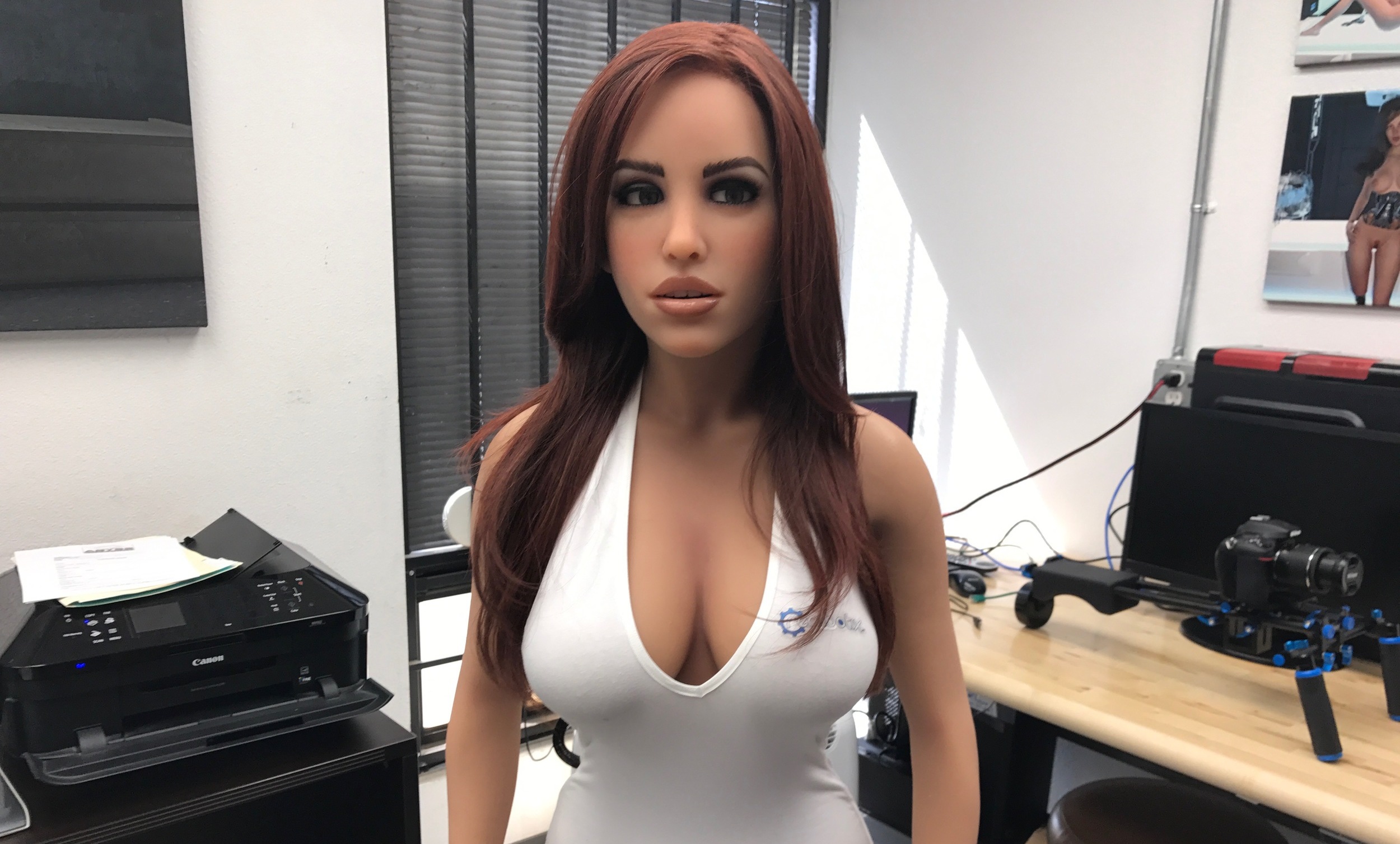 For years and years, the idea of having the “perfect lover” has always crossed our minds, and now with the right technology, it’s finally happened. They have started selling different body parts such as mouths, genitalia, and full-bodied robots as well. Although they are very expensive, they are in very high demand. Harmony is one of the first sex robots to be made with little movement. There are people who are against these sex robots, however, implying that they’re slaves and a different way to say that women are just sex objects and nothing more.
Works Cited
Bianco, Marcie. “The Difference of Life in Spike Jonze's Her.” The Huffington Post, TheHuffingtonPost.com, 9 Jan. 2014, https://www.huffingtonpost.com/marcie-bianco/the-difference-of-life-in_b_4550183.html


I find the question “Are humans really connected anymore?” is becoming more and more of a serious concern in our society. I agree with what your group said: people are becoming so wrapped up in technology that they are forgetting about the real relationships we have with one another. Everyone’s prime focus is having the newest of phones and laptops. The only upside to technology is that it still keeps people connected, only virtually. Walking in the halls of schools and even public places, all you see when you look around are people talking on the phone, sitting on the phone, and walking while also on their phone. Soon people are going to forget how to even communicate in person, they are going to permanently talk in abbreviations.
ReplyDeleteI don't think I would ever have my own operating system similar to Samantha because to be completely honest, it would creep me the hell out. I already experience the uncanny feeling while interacting with Siri or even Alexa, and they don't even have feelings! So for them to have emotions and a personality would just be a step to far for me. I went to see this play called Marjorie Prime in February with my english class. This was about Primes (robots) mimicking the physical appearance of a dead loved one. It has basically the same operating system as Samantha but with the body of the deceased. Although it's a great way to help them deal with death, it was pretty much awkward to watch them have a relationship. Thankfully they did not have sexual intercourse with their loved ones, I don't think I would want to have anything to do with these inventions... because in a way, in both cases, they aren't real people, which could hurt you even more in the long run.
ReplyDeleteThis comment has been removed by the author.
ReplyDelete"Do you think the intelligence of operating systems can really evolve over time or is that evolution programmed?" I think that the intelligence of the operating systems can really evolve over time because for example robots like HERB learn by experience, he takes information in and processes it intelligently in the context of everything he knows already about his world. In the movie, for example, Samantha evolved with experience too. She evolved in the sense that she started to know herself more and she acted based on past experiences she had with Theodore. I think that OSes, even in the present, are highly intelligent and they can learn things by themselves. The creators of these OSes only need to program the bases of their learning structure and the OSes do the learning by themselves, similar to what human beings do. We are born with all the tools to learn and we use them to learn by ourselves, from experiences.
ReplyDeleteDo you think the intelligence of operating systems can really evolve over time or is that evolution programmed?
ReplyDeleteFirst, take a look at the definition of algorithm: “a process or set of rules to be followed in calculations or other problem-solving operations, especially by a computer”. As technology advances and understanding of more complex patterns come out we get to see that computers have already evolved. Take Siri for example, even though it isn’t sentient like Samantha, it can identify and recognize certain words and operate accordingly. Of course, it doesn’t have cognition, but with patterns already stablished it can direct you in the right path to the solution, e.g., ask it how to fix your bathtub and it will give you plumbers’ names. So definitely yes, they can and will. (114)
During the review you asked a very intriguing question; What was the difference between a sentient operating system and the girl on the dating app? I think that it is extremely important for present and future generations to understand just how drastic the difference is between an operating system and a human on a dating app, even if this operating system is sentient it cannot fulfill what we as humans need, to completely feel and love. Although someone on a dating app might be a way for a very short term relationship, this relationship still allows to be in contact with an actual human being with flesh, a brain, a heart, etc... The operating system might have sentience, although through the analysis of this movie I notice how he was more in love with the idea of "her" being in his life, as she was not an actual individual, she was made to attend to his own personal needs, she knew so much about him without really getting to know him. Love comes with arguments, tension and having different ways of thinking about things that allow a relationship to grow stronger and blossom. Although she was there to make sure he was happy and felt fulfilled, thus, not allowing for a true bond to progress. Also as humans we need human contact, which is also something that allows for the love you can have for someone to expand, as this has been part of our biological make-up since we were primates.
ReplyDeleteI think that Alison made a great point. However, if human physical contact is only what Samantha lacks, would it be more “acceptable” if Samantha had a body perhaps? If we take, for instance, the people who initiate relationships on the internet without meeting each other (e.g. long-distance relationships), in some cases, they develop romantic feelings for each other. They might lack the physical part of the relationship but that does not necessarily mean that they lack sexual attraction for each other. Similarly, Theodore feels attracted to Samantha so if Samantha can satisfy Theodore sexually (or vice versa), would that make it normal taking into consideration that Samantha is a sentient being who hypothetically possess a body? Or in other words, how is that different from a relationship between two people online who never met each other?
DeleteI think it’s incredibly important to look at how our society is evolving due to the connection many of us have to technology and the group’s point about questioning whether or not humans are connected anymore is crucial. This can be linked back to the very beginning of this course’s content, more specifically when we did the techno fast. The techno fast allowed us to see the world as an unplugged being while the majority of the society we’re surrounded by are plugged in. This exercise was able to show us how disconnected our society is to each other due to the technology that we do heavily depend on. There are many positives to technology in many different aspects but when looking at it socially it has become a dependency that affects many individuals’ emotional well being. When looking at the film “Her”, we see a man falling in love with an operating system. The technology is so advanced that it is powerful enough to create these emotions for him. This demonstrates the power technology has on human beings as well as how easily it may disconnect people from the real world.
ReplyDelete